2026 Nissan Rogue vs 2026 Kia Sportage: Two Compact SUVs, Two Very Different Personalities
April 22 2026,
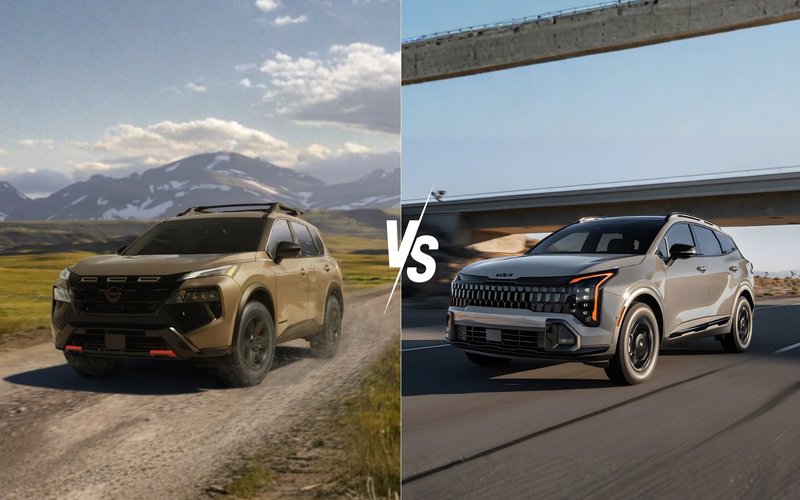
Choosing between these two popular compact crossovers isn’t as straightforward as it seems. Both deliver modern styling, advanced safety, and everyday usability, but they approach performance, comfort, and technology in distinctly different ways. One leans into efficiency and innovation, while the other focuses on simplicity and proven reliability.
Let’s break down what truly sets them apart.
Build & Price your own 2026 Nissan Rogue
Performance That Defines Driving Feel

Under the hood, the Rogue features a 1.5-litre turbocharged three-cylinder engine producing 201 horsepower and 225 lb-ft of torque. This engine stands out for its variable compression technology, which dynamically adjusts performance for both power and fuel savings.
It is paired with a continuously variable transmission (CVT), delivering smooth acceleration and optimized fuel efficiency. On the other hand, its rival, the Sportage, uses a naturally aspirated 2.5-litre four-cylinder engine producing around 187 horsepower and 178 lb-ft of torque.
Instead of a CVT, it comes with a traditional automatic transmission, which some drivers may prefer for its familiar feel. While it doesn’t quite match its competitor's efficiency, it delivers consistent and predictable performance.
Ride Quality and Everyday Comfort
When it comes to ride experience, both models cater to different preferences. The turbocharged option offers a quieter, more refined drive, especially on highways, thanks to its smaller engine operating more efficiently at lower RPMs.
Meanwhile, the alternative focuses on comfort and stability, making it idyllic for city driving and everyday commutes. Its suspension tuning leans toward a softer ride, absorbing bumps with ease.
Wheel sizes vary by trim, but both models offer 19- or 20-inch alloy wheels, enhancing aesthetics and road presence.
Interior Space and Cargo Versatility

Space is a crucial factor in this segment, and both vehicles deliver strong practicality. The turbocharged model offers up to 2,064 litres of cargo space with seats folded, along with about 1028 litres behind the second row. The Sportage five-passenger SUV provides 1,121 litres (39.6 cu ft) of cargo space behind the back seats, expanding to 2,098 litres (74.1 cu ft) when the rear seats are folded flat.
Its competitor is known for slightly more flexible cargo configurations and a wide-opening rear hatch, making loading and unloading easier for families.
Passenger comfort is comparable in both, with ample legroom and supportive seating. However, subtle differences in seat cushioning and cabin materials may influence personal preference.
Technology That Shapes the Cabin Experience
Technology is where things become more interesting. One model features a user-friendly infotainment system with available larger touchscreen displays and intuitive controls. Its interface is designed for simplicity, reducing distractions while driving.
The other pushes a more futuristic approach, offering a 12.3-inch infotainment screen along with a matching digital instrument cluster.
Wireless smartphone connectivity, voice commands, and advanced navigation features are expected on both, but the latter leans more toward a high-tech, visually immersive setup.
Safety Innovations That Inspire Confidence
Safety remains a strong point for both vehicles. The first model is equipped with a comprehensive driver-assistance suite, including features like adaptive cruise control, lane-keeping assist, and automatic emergency braking.
What makes it unique is predictive forward collision warning, which monitors not just the vehicle ahead but also the one in front of it, adding an extra layer of awareness.
The competing model also offers advanced safety systems, including blind-spot monitoring and highway driving assist, to make long-distance travel less stressful.
Efficiency vs Simplicity: What Matters More?
Fuel efficiency is where the turbocharged engine truly shines, delivering impressive mileage for its class. Meanwhile, the naturally aspirated engine prioritizes reliability and ease of maintenance, which can appeal to long-term owners.
Transmission differences also play a key role, one emphasizes smoothness and efficiency, while the other offers a more traditional driving feel.
Which One Should You Choose?
If you value fuel efficiency, innovative engineering, and a refined driving experience, the turbocharged option stands out. However, if you prefer a straightforward engine, modern styling, and a more conventional transmission, the alternative is a strong contender.
Ultimately, the conclusion comes down to your driving habits and what you expect from your daily commute.
Trim Comparison Chart
|
Vehicle Features |
Nissan Rogue |
Nissan Sportage |
|
Fuel Economy (combined) |
7.6 L/100 km |
8.3 L/100 km |
|
Wheels |
17-inch Aluminum-alloy wheels |
|
|
Audio system |
Bose® Premium Audio System 10 speakers, including dual-driver woofer |
Harman Kardon® premium audio system |
|
Towing capacity |
1,500 |
2,500 lbs |
|
Passenger Seats |
5 passengers |
|
|
Fuel Tank Capacity |
55 litres |
54 litres |
|
Price |
$37,388* |
$35,174* |
Find Your Perfect SUV Today
Still deciding between the 2026 Nissan Rogue vs the 2026 Kia Sportage? Visit Regina Nissan in Regina to explore your options in person. Their team can help you compare features, schedule a test drive, and find the model that fits your lifestyle perfectly.
